

How to Run Invitation and Registration Campaigns in the UAE?

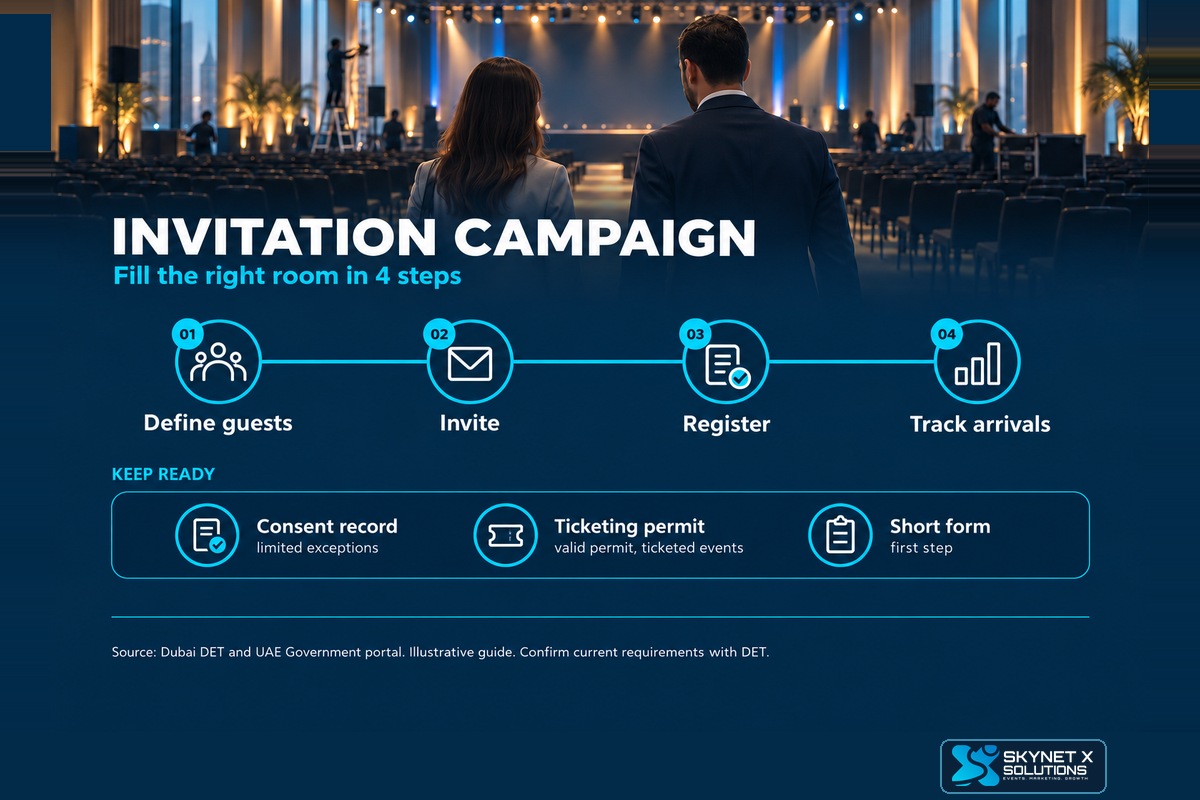
A strong invitation and registration campaign starts with the room you want to fill, not the list you already have. Define the guests who must attend, choose who invites them, keep the form short and track registered, confirmed and arrived guests separately. For UAE events, two official points also need checking: DET ticketing rules when tickets are issued, and consent under the UAE data protection law when you contact people.
• Define the guests who must attend before you write any invitation.
• DET states that a ticketed event requires a ticketing permit for every ticketed event.
• The UAE Government portal says the data protection law prohibits processing personal data without consent, with limited exceptions.
• Track registered, confirmed and arrived guests as three separate numbers with named owners.
• Keep the first registration form to the essentials and collect more later.
In This Article
1. How to Plan an Invitation and Registration Campaign for a UAE Corporate Event
2. Registration Rules and Consent Shape Your Campaign in Dubai
3. Build the Invitation Sequence Around Decision Makers
4. Design the Registration Page to Reduce Drop Off
5. What This Means for Your Brand
How to Plan an Invitation and Registration Campaign for a UAE Corporate Event
An invitation and registration campaign for a UAE corporate event works when it is built backwards from the room you want to fill. Start with the people who must attend for the event to succeed, then design the invitation, the registration page and the follow up around them. Volume is a by product of that discipline, not the goal.
Most corporate events in Dubai fail on registration for a simple reason. The invitation goes to a large list, the form asks for too much, and nobody owns the gap between a registration and an arrival. A campaign plan fixes those three problems before a single message is sent.
Begin with a one page audience definition. List the job titles, sectors and decision rights of the guests who matter, and name the number of seats you want each group to fill. A government delegation, a bank treasury team and a startup founder community need different messages, different senders and different timing.
Be specific about the promise. Guests respond to a clear reason to attend, such as a named briefing, a closed door discussion or a defined set of introductions. A general invitation to an event with no stated value competes poorly with a full diary.
Then set the registration outcome you are measuring. Registered, confirmed and arrived are three different numbers, and each needs its own owner. Agree these definitions with your events team and your agency before the first invitation goes out.
Registration Rules and Consent Shape Your Campaign in Dubai
Two sets of official rules affect how an invitation campaign runs in the UAE. The first applies when you sell or issue tickets, and the second applies to how you handle the personal data of the people you invite.
On ticketing, Dubai's Department of Economy and Tourism (DET) states that organisers with a valid Ticketed Event permit must apply for Ticketing and select an approved ticket seller or registration provider to comply with regulations. DET also says that a ticketed event requires a ticketing permit for every ticketed event. If your registration page issues paid or controlled tickets for a Dubai event, confirm with your venue and agency who holds that permit and which provider is approved before you publish the page.
On data, the UAE Government portal explains that the Personal Data Protection Law prohibits the processing of personal data without the consent of its owner, except in limited cases set out in the law. For an invitation campaign, this means your contact list, your registration form and your follow up messages should each have a clear basis for use. Ask your legal team to confirm how consent is captured and recorded for your list.
These rules change over time, so confirm current requirements with DET and the relevant data authority before launch. Our guide on which permits a corporate event in Dubai needs sets out the permit side in more detail. Treat that checking step as part of the campaign schedule, not as a last minute task.
Build the Invitation Sequence Around Decision Makers
A good invitation sequence has a clear order. A personal note from a senior host goes first, a formal invitation with the programme follows, and a short reminder closes the loop. Each message has one job and one action.
The first message should come from a person the guest knows or respects. For a corporate or government audience, that is usually a senior executive, a partner organisation or the event host. Keep it short, name the reason the guest was chosen, and ask for one reply.
The formal invitation carries the programme, the venue, the date and the registration link. Put the benefit to the guest in the first line, not the history of your company. Guests decide in a few seconds whether the event is relevant to their role.
Timing matters as much as wording. Send invitations on working days and avoid clashes with public holidays and major regional events in your sector. Check the calendar of your target guests before you fix the send dates.
The reminder should add something new, such as a confirmed speaker, a named session or a practical detail about arrival. Repeating the same message does not raise attendance. Giving the guest a fresh reason does.
For senior and official guests, the sequence changes. Invitations often route through offices and assistants, and protocol matters. Our article on which Dubai agency handles government and VIP delegations explains how that handling works in practice.
Design the Registration Page to Reduce Drop Off
The registration page is where most campaigns lose people. Every extra field costs registrations, so ask only for what the event needs to function. Name, company, job title and a confirmed email are usually enough for a first step.
Place the essentials above the fold. That means the event name, the date, the venue, a short programme and the register button. A guest who has to scroll to learn where the event is held will often leave.
Use a confirmation message that does real work. It should repeat the date and venue, add calendar details, explain how to arrive and tell the guest what to bring. For events with security checks or named access, say so in the confirmation so there are no surprises at the door.
If you need extra information, collect it later. A second short form after registration, sent to confirmed guests only, gets better answers than a long first form. This also keeps your data collection narrow, which supports the consent practices described above.
A single registration number hides what is happening. Track registered, confirmed and arrived guests as separate lines, and review them at a fixed point each week. The gaps between those lines tell you where the campaign needs help.
If registrations are low, the invitation list or the message is the problem. If registrations are high and confirmations are low, the follow up is the problem. If confirmations are high and arrivals are low, the event day experience or the reminder timing needs attention.
Assign a named owner to each gap. One person manages the list and the invitations, another manages confirmations and guest contact, and another manages arrival and check in. For B2B formats, add the meeting plan as a fourth workstream, because guests who have booked meetings arrive more often. Our guide to [planning buyer meetings at B2B events](https://www.snxs.ae/post/b2b-events-agency-uae-buyer-meeting-planning) shows how that planning works.
Review the list weekly with your agency. Remove duplicates, correct titles and mark which guests have responded, so that follow up goes only to people who still need it. A clean list also protects your sender reputation and makes consent records easier to maintain.
Plan the check in process with the same care. Names, badges, queues and access lists are part of the campaign, because the guest experience at the door shapes whether they accept the next invitation.
What This Means for Your Brand
For most UAE corporate teams, the campaign comes down to five decisions made early. Who exactly are you inviting, who sends the invitation, what does the registration page ask, who holds any ticketing permit, and how will you measure arrivals. Answer those in a single brief before the creative work begins.
Keep the campaign narrow and honest. A smaller list of well chosen guests, contacted with consent and followed up with care, produces a better room than a large list contacted once. That room is also easier to report on afterwards.
Review each campaign after the event. Compare registered, confirmed and arrived numbers, note which messages worked, and carry those lessons into the next brief. Over several events, this record becomes the most useful asset your events team owns.
If you are planning an event in Dubai or across the region and want the invitation, registration and on site plan built as one system, talk to the SNXS team about your brief.
FAQ
Q: How far ahead should an invitation campaign start for a UAE corporate event?
A: Start once the audience definition, date and venue are confirmed, and allow time for a personal note, a formal invitation and at least one reminder. Senior and government guests need more lead time because invitations route through offices.
Q: Do I need a permit to sell tickets to a corporate event in Dubai?
A: DET says a ticketed event needs a ticketing permit for every ticketed event. Confirm with DET and your venue whether your format counts as ticketed and who will hold the application.
Q: What does UAE data protection law mean for event invitations?
A: The UAE Government portal says the law prohibits processing personal data without the owner's consent, with limited exceptions. Ask your legal team how your list and form capture consent.
Q: How many fields should a registration form have?
A: Keep the first form to name, company, job title and email. Collect extra details later from confirmed guests only.
Q: What should a reminder message contain?
A: Add something new, such as a confirmed speaker, a session or an arrival detail. Repeating the original message does not help.
Q: Who should own the registration campaign?
A: Give the list and invitations, confirmations and guest contact, and arrival and check in to named owners. Agree the three definitions of registered, confirmed and arrived before launch.
Need help turning industry trends into business growth?
Get in touch!
At SNXS, we help startups, enterprises, and government organizations navigate AI, blockchain, Web3, fintech, and digital transformation through strategic consulting, event management, marketing, PR, content, and community building.
Whether you're launching a product, expanding into the MENA region, building your brand, or growing your community, our team is ready to help.
👉 Our Services: https://www.snxs.ae/services
👉 Portfolio: https://www.snxs.ae/portfolio
👉 Store & Digital Products: https://www.snxs.ae/category/all-products
👉 What's Coming Next – MENA AI Week: https://www.menaaiweek.ae/
👉 Business Registration Services: https://www.snxs.ae/business-registration
👉 Request a Quote: https://www.snxs.ae/get-a-quote
👉 Book a Free Consultation: https://www.snxs.ae/book-online
🌐 Visit SNXS: https://www.snxs.ae


Comments