

How Should AI Startups Pitch at Dubai Awards?

An AI startup should treat a Dubai awards presentation as a test of a specific user outcome, not a stage for broad claims. Name the problem, show a working task, identify the limits, and give each judge or buyer a route to verify what happened. The Create AI Agents Championship announcement makes this distinction useful for founders planning a prototype pitch, demo video, or live event.
• The Create AI Agents Championship was announced by Dubai Government Media Office on 7 October 2026, following the Create Apps Championship awards.
• Dubai Chamber of Digital Economy hosts the official Create AI Agents application route for innovators and teams.
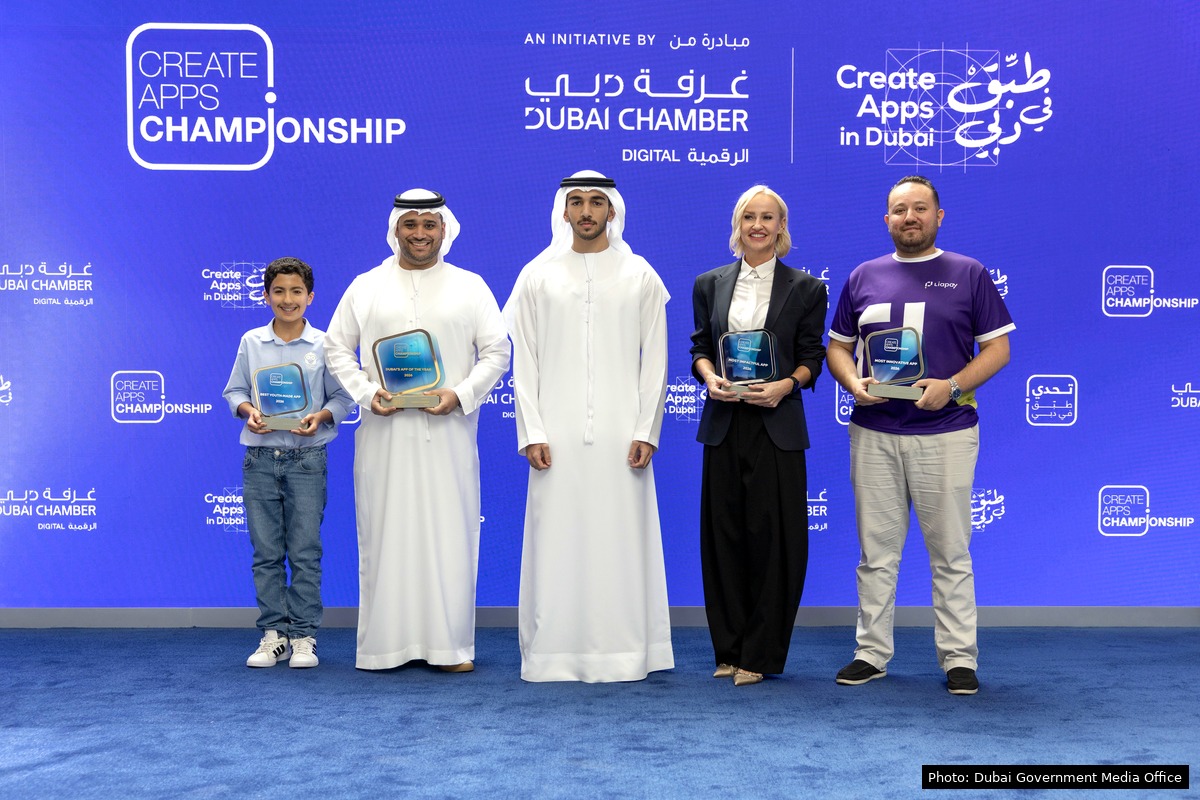
• The Create Apps Championship awards photograph shows the named event backdrop and real award recipients, not a future agent product.
• The official 2026 announcement describes a prototype, pitch deck and demo video as materials expected at the application stage.
• The Create AI Agents Championship has four named categories, covering societal, personal, business and youth use cases.
In This Article
1. A Startup Awards Demo Needs a Verifiable User Journey
2. Dubai's Championship Separates Eligibility From Proof
3. A Dubai AI Event Brief Connects Stage Design to Buyer Evidence
4. What This Means for Your Brand
A Startup Awards Demo Needs a Verifiable User Journey
A strong demo starts with a real task, an intended user, and a result that an observer can inspect. A founder can introduce the context in plain language, show the starting material, and walk through the application as a user would. The audience should know which steps the system performed and which steps were completed by a person. If the solution is still a prototype, describe it as a prototype and distinguish a controlled demonstration from a service available to customers.
This matters particularly when a competition asks for both product development and a pitch. The official Dubai Government Media Office account says the Create AI Agents Championship asks participants to identify priority problems, design solutions, test their impact, and assess whether they can become viable products or services. That is a useful sequence for a buyer presentation even when the brand has no connection to the competition. It forces the team to explain the value of the task before showing the interface.
A stage presentation has a different risk profile from a recorded product tour. Screens may be hard to read from the back of the room. A network connection can fail. The production brief therefore needs a legible demonstration path, a backup recording clearly labelled as such, and a technical owner who can explain how the output was produced.
1. Define the user. State whose task is being improved and why the problem warrants attention before describing the tool. A specific user journey gives the room a basis for judging the result, and makes it easier to separate a meaningful demonstration from an attractive interface.
2. Show the input. Identify what material enters the system, whether it is simulated, and what permissions the team has to use it. A screen filled with fabricated production data can undermine the entire presentation if viewers mistake it for a real customer record.
3. Make the result inspectable. Show the output and explain the decision a person can now make. If a task requires review or correction, identify the reviewer and show where that review takes place.
4. Record the boundary. Say what the prototype cannot do, which integrations are not complete, and what has not been evaluated. That boundary is useful to an institutional buyer because it clarifies what would need testing before procurement.
5. Assign the next step. Tell a relevant audience member how to request a deeper technical session, who owns that conversation, and which evidence will be available. A memorable stage moment without an accountable follow up rarely advances a buying decision.
Dubai's Championship Separates Eligibility From Proof
The official championship application page is a practical point of reference for applicants, while the October announcement explains the programme's shift from digital applications toward agent systems integrated into practical uses. That difference should shape a founder's event narrative. Saying that a technology belongs to a fast growing category does not show how it performs a task for a person. A presentation should demonstrate the job, the workflow, and an outcome that can be checked.
The announcement says individuals and teams can enter with an idea, prototype, or early stage product, while existing businesses can submit a new agent capability. It also says fully commercialised solutions are not eligible. Applicants should consult the live official application instructions before treating those descriptions as final requirements. A founder making a commercial sales presentation should not imply that an awards programme has validated the product, or that appearing at a competition is a government endorsement.
The photographed Create Apps Championship award moment illustrates what an audience can identify in an event image: the programme name, the stage, and the people receiving recognition. It does not establish that the pictured winners have entered the new competition, or that SNXS produced the ceremony. This article uses the image as a concrete reference for an awards setting, not as evidence of agency involvement or product performance.
A Dubai AI Event Brief Connects Stage Design to Buyer Evidence
An AI product pitch needs two briefs that agree with each other. The editorial brief sets out the buyer question, approved claims, source material, and proof points. The production brief defines how those points become visible in the room and usable after the event. If the presenter changes a claim during rehearsal, the event team should confirm the supporting evidence before updating a screen, host introduction, or social caption.
For a Dubai event, the organiser should confirm venue conditions and any event permissions with the relevant authority and venue rather than infer them from another event. The production team should test power, connectivity, sightlines, audio, accessibility, and the timing of any audience interaction. These are planning questions, not claims that one location or approval route applies to every format. Dubai Chamber of Digital Economy provides the institutional context for its digital entrepreneurship programmes; it is not a substitute for a venue specific production or permissions check.
SNXS describes its event and marketing services for teams planning this kind of buyer journey. An agency can coordinate the room, production partners, content and follow up, while the founder remains accountable for the technical claim. The related government service demonstration guide considers an institutional service journey, while the technology unveiling brief focuses on evidence at a launch.
This awards pitch guide is different: it addresses a startup's prototype and judge or buyer conversation. For another example of a multi audience Dubai programme, the official MENA Blockchain Week report documents a distinct event initiative. It is not a claim that the two programmes share organisers, sponsors, or participants.
What This Means for Your Brand
Before approving a production concept, ask the team to run the entire demonstration without promotional narration. Can a person see the starting point, the action, and the result? Does a technical reviewer understand the scope of the trial? If either answer is unclear, revise the event narrative before adding screens or motion graphics.
The recent Dubai Government Media Office announcement gives the immediate editorial context, but the buyer lesson stands independently of a competition calendar. Specific proof creates a more credible conversation than a broad claim of innovation. If your team is planning an AI showcase in Dubai, map the user task, demonstration, evidence owner, room design, and follow up route before approving the creative treatment. The goal is to help the right person make an informed next decision.
FAQ
Q: How should an AI startup start an awards demo in Dubai?
A: Begin with the user problem and a real task, then show the starting input and the output. Identify which parts are a prototype and who checks the result before presenting it as reliable.
Q: What evidence should a judge see in an AI agent pitch?
A: Show the system action, the resulting output and the boundaries of the test. An observer should be able to distinguish a live demonstration from a backup recording and a human assisted step.
Q: Can an early stage product apply to the Create AI Agents Championship?
A: The official announcement describes eligibility for ideas, prototypes and early stage products, but excludes fully commercialised solutions. Check the live official application instructions before submitting because programme requirements may change.
Q: Does an awards appearance mean a product has official endorsement?
A: No. A presentation or application is not evidence that a government authority has endorsed, purchased or deployed a product. Describe the precise stage reached and source any award claim to its official result.
Q: What should an agency own at an AI startup showcase?
A: The agency can coordinate stage design, legibility, rehearsal, accessibility, production and attendee follow up. The founder and technical owner remain responsible for the truth and limits of product claims.
Q: How can a Dubai awards demo generate useful buyer conversations?
A: Invite the right audience to inspect a specific task and record questions with consent. Assign an owner to a requested proof item or technical session rather than treating general attendance as a qualified lead.
Need help turning industry trends into business growth?
Get in touch!
At SNXS, we help startups, enterprises, and government organizations navigate AI, blockchain, Web3, fintech, and digital transformation through strategic consulting, event management, marketing, PR, content, and community building.
Whether you're launching a product, expanding into the MENA region, building your brand, or growing your community, our team is ready to help.
👉 Our Services: https://www.snxs.ae/services
👉 Portfolio: https://www.snxs.ae/portfolio
👉 Store & Digital Products: https://www.snxs.ae/category/all-products
👉 What's Coming Next – MENA AI Week: https://www.menaaiweek.ae/
👉 Business Registration Services: https://www.snxs.ae/business-registration
👉 Request a Quote: https://www.snxs.ae/get-a-quote
👉 Book a Free Consultation: https://www.snxs.ae/book-online
🌐 Visit SNXS: https://www.snxs.ae
Photo source: Dubai Government Media Office https://mediaoffice.ae/en/news/2026/october/07-10/hamdan-bin-mohammed-launches-create-ai-agents-championship


Comments